



Enlarge Text
A Cut Above the Rest
Advances take Department of Surgery to the Top
The first surgical cut may not always be the deepest but any incision through skin poses potential health risks. Surgeons cut – to treat injuries and cure diseases – and they have done so for eons. From drilling holes in the skull to relieve migraines in prehistoric times to excising tumors with high-tech lasers in the modern world, the art and science of surgery has continued to evolve to become, thankfully for patients, increasingly sophisticated. Today, the surgeon’s proverbial knife still sees a lot of action but in innovative ways that maximize safety and minimize complications.
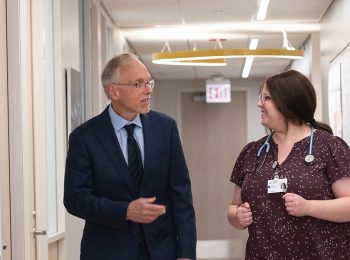
“We’ve come a long way even over the past 20 years,” says Nathaniel J. Soper, MD, Loyal and Edith Davis Professor and chair of surgery at Northwestern University Feinberg School of Medicine. “We’ve gone from traditional, large ‘open’ incisions to minimally invasive surgery, which may be a bridge to operations without incisions.”
Yet surgical procedures are only one part of the equation for achieving optimal patient safety and outcomes. Everything that comes before, in-between, and after surgery has much to do with its success. Embracing a vision of “Safer Surgery Today, Better Surgery Tomorrow” to describe its clinical as well as academic activities, the Department of Surgery has been using the theme liberally to drive advances.
‘Open-ing’ Surgery
Why create an opening, when one already exists? The natural orifices of the human body have recently become a new frontier for further dialing down the invasiveness of surgical procedures such as gallbladder removal. Back in the day, surgeons typically took out the small bile-storing organ by cutting into the abdomen, increasing the possibility of pain and infection. Most patients now routinely undergo laparoscopic procedures. Surgeons insert a laparoscope, a slender lighted tube, through one of several small cuts made on the belly to take out the gallbladder. In the future, the mouth or the vagina may become popular gateways for this and other common surgical procedures, with no exterior incisions required.
“Laparoscopic procedures have greatly improved patient outcomes but they still involve incisions on the skin and potential time off work,” says Eric S. Hungness, MD, GME ’05, assistant professor of surgery, who specializes in advanced minimally invasive gastrointestinal procedures. “Over the last five years, efforts have been made to move minimally invasive endoscopic surgery to the next level so we can do even more complicated procedures. That’s when NOTES came about.”
Natural Orifice Transluminal Endoscopic Surgery, or NOTES, encompasses unique “scarless” procedures that employ natural pathways into the human body such as the mouth, vagina, and rectum. About four years ago, Dr. Hungness and colleagues launched the department’s first experience with NOTES by performing down the mouth, transgastric – or through the stomach – gallbladder surgery. The mouth serves as both the entrance and exit for organ removal. And the only incisions are made internally. While the four patients who underwent this procedure at Northwestern Memorial Hospital experienced less pain compared with standard laparoscopic surgery, the novel approach proved quite difficult.
“These techniques are so new that we don’t have access to equipment specifically designed for them,” explains Dr. Hungness. “Also, because the gallbladder sits in the upper right hand corner of the abdomen, you almost have to do a U-turn to target it.”
Continuing to explore what surgical improvements NOTES can offer gallbladder patients, Dr. Hungness has shifted his focus to a different orifice: the vagina. Working with gynecologist Magdy P. Milad, MD, professor of obstetrics and gynecology at the Feinberg School, the Department of Surgery has started performing transvaginal gallbladder surgeries in women. The procedure results in fewer incisions, less pain, and a more rapid return to everyday activities.
In addition to NOTES, another surgical acronym has recently entered the department’s vernacular: POEM or Per-Oral Endoscopic Myotomy for esophageal achalasia. A severe swallowing disorder, achalasia occurs when the muscle at the bottom of the esophagus refuses to relax and inhibits the passage of food and liquids. While laparoscopic procedures are the current standard of care, POEM offers an incision-free alternative. Surgeons insert instruments down the mouth and then tunnel through the esophageal wall to cut the muscle bundle causing problems. This past October, Northwestern became only the second medical center in the nation to perform POEM.
“POEM is true NOTES,” says Dr. Hungness, one of a handful of U.S. surgeons trained in the procedure. “There are no incisions on the skin, which means there should be less pain. The procedure is also 30 to 60 minutes faster than the traditional Heller myotomy.”

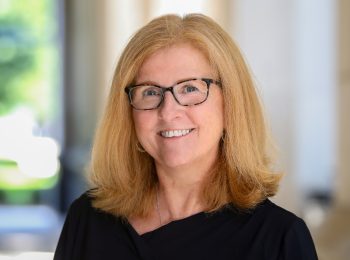
Melina R. Kibbe, MD, GME ’03, the Department of Surgery’s Vice Chair of Research, hopes to further improve their rankings in NIH Research funding.
Safety in Numbers
In 2006 Northwestern University Feinberg School of Medicine’s Department of Surgery ranked 56th in NIH research funding. In five short years, the department’s stature and success in securing federal grant dollars has catapulted it to number 15. Give her another five to 10 years and Melina R. Kibbe, MD, GME ’03, the department’s new vice chair of research, hopes to have that ranking in the single digits.
“Before I accepted this position, I did my due diligence and interviewed six vice chairs of research at the top 10 institutions,” shares Dr. Kibbe, Edward G. Elcock Professor of Surgical Research and associate professor of surgery in the Division of Vascular Surgery. “It gave me a great perspective on what we need to do as a department to get ourselves into the top 10.”
An accomplished surgeon-scientist, Dr. Kibbe views the department as well situated for future growth in the five key areas of research: basic, translational, health services, education, and outcomes. Patient safety and surgical outcomes research, in particular, contribute a great deal to the department’s overarching vision to improve surgical safety. Medicine in general has focused on “do no harm” initiatives in the last decade since the Institute of Medicine released its scathing 1999 report on medical errors running rampant in the U.S. health system. However, the invasive nature of surgery and the complications that can arise from it provide much room for improvement. The complexity of transplant surgery, for example, stresses health care resources like no other surgical procedure. This characteristic actually provides a rich resource for studying patient safety.
“Transplant surgery is a perfect training ground for researching safety issues,” says transplant surgeon Daniela P. Ladner, MD, MPH, director of the Northwestern University Transplant Outcomes Research Collaborative(NUTORC). The inter-school, multidepartment, trans-disciplinary NUTORC investigates all aspects of the transplant experience related to health services and outcomes. “The complexity of transplantation offers observations to vulnerabilities of systems and processes of care that would be difficult to observe in other specialties without studying very large patient numbers, but the significance of our findings goes beyond our area.”
Further strengthening its emphasis on enhancing quality and safety, in August the department launched a major initiative: the Surgical Outcomes Research and Quality Improvement Center (QIC). Headed by surgical oncologist Karl Y. Bilimoria, MD, MS, GME ’10, assistant professor of surgery, the center works locally to improve the quality and safety of surgery at NMH, conducts both scientific and practical outcomes research, and collaborates at the national level with the American College of Surgeons (ACS). A research fellow at the professional association while completing his residency training, Dr. Bilimoria worked extensively on the ACS’s National Surgical Quality Improvement Program (NSQIP). Analyzing outcomes data from participating hospitals nationwide, including Northwestern Memorial, NSQIP provides outcomes feedback to improve surgical care. With the new center, says Dr. Bilimoria, who holds a dual appointment at the ACS, “We at Northwestern are uniquely positioned to translate our quality and safety research studies to the national level.”
As vision statements go, the one chosen by the Department of Surgery has provided a roadmap to excellence that can’t be disputed. “It does weave a good story,” says Dr. Soper. “It’s a vision that pulls together all the seemingly disparate things we do in this department. We measure what we are doing and strive to improve outcomes. We innovate new operative procedures to positively impact the individual patient’s experience. We teach our medical students and surgical trainees what we have learned along this pathway. All of these efforts ultimately converge on these two aspects: safety and quality improvements in the surgical care of patients.”